On learning
Or, how to build a better library.

Last month I did something that, frankly, surprised even me.
I stopped using Duolingo.
After finishing a streak of 2,437 days, mind you.
To be clear, I love Duolingo.
The streak, which began in the summer of 2019, certainly shows it.
I enjoy the games and characters—especially Lucy, with her mysterious spy backstory that pops up throughout the lessons.
The app has turned language learning into something that feels less like homework and more like a small daily adventure.
It was fun.
And gamifying education is hardly new.
I remember my rather severe high school Spanish teacher, Señora Bota—who hailed proudly from Spain—drilling us on how to roll our r’s and stretch the diphthongs of Castilian pronunciation.
If you managed to pronounce everything correctly, you might earn a few bonus points toward the weekly quiz.
Which, truth be told, most of us approached with the quiet dread usually reserved for dental work.
Still, games have their place.
They make learning approachable.
But in the end, they remain…games.
⸻
The Limits of the Game
Early education often relies on games to teach foundational ideas—from math to reading, phonics to spelling. (Do they still teach phonics? I genuinely don’t know anymore.)
But a game cannot fully replicate the deeper push toward understanding.
Toward nuance.
Toward vocabulary.
Toward insight.
To its credit, Duolingo probably does this better than anyone.
And this essay is not meant as a criticism of the platform.
If you want to begin learning any language, Duolingo is an excellent place to start.
The difficulty—if there is one—lies in retention.
⸻
Ten Minutes of Genius
Duolingo’s numbers are impressive.
In an early 2026 earnings call, CEO Luis von Ahn noted the company reached a milestone in 2025: more than 50 million daily active users.
But in the same call he mentioned something equally revealing.
Only about 10 percent of monthly users pay for the service. Most people use the free version of the app.
And the average user?
They spend roughly ten minutes a day learning a language.
In other words, many of us treat it less like a discipline and more like a game.
In the same earnings call, von Ahn spoke about future growth—not necessarily by expanding the depth of language instruction, but by allowing users to customize their avatars.
Gaming, indeed.
⸻
The Old Ways
Ten minutes a day is, of course, not a substantial way to learn a language.
So what is?
For me, the best method often turns out to be the oldest one.
You begin with a book.
And a dictionary.
And you work slowly through the text.
This past weekend, while traveling to and from Fredericksburg, my partner and I stumbled upon a used book sale at their local library.
Yes—this is the kind of couple we are.
More interested in books (and barbecue) than the wine-tasting rooms down the street.
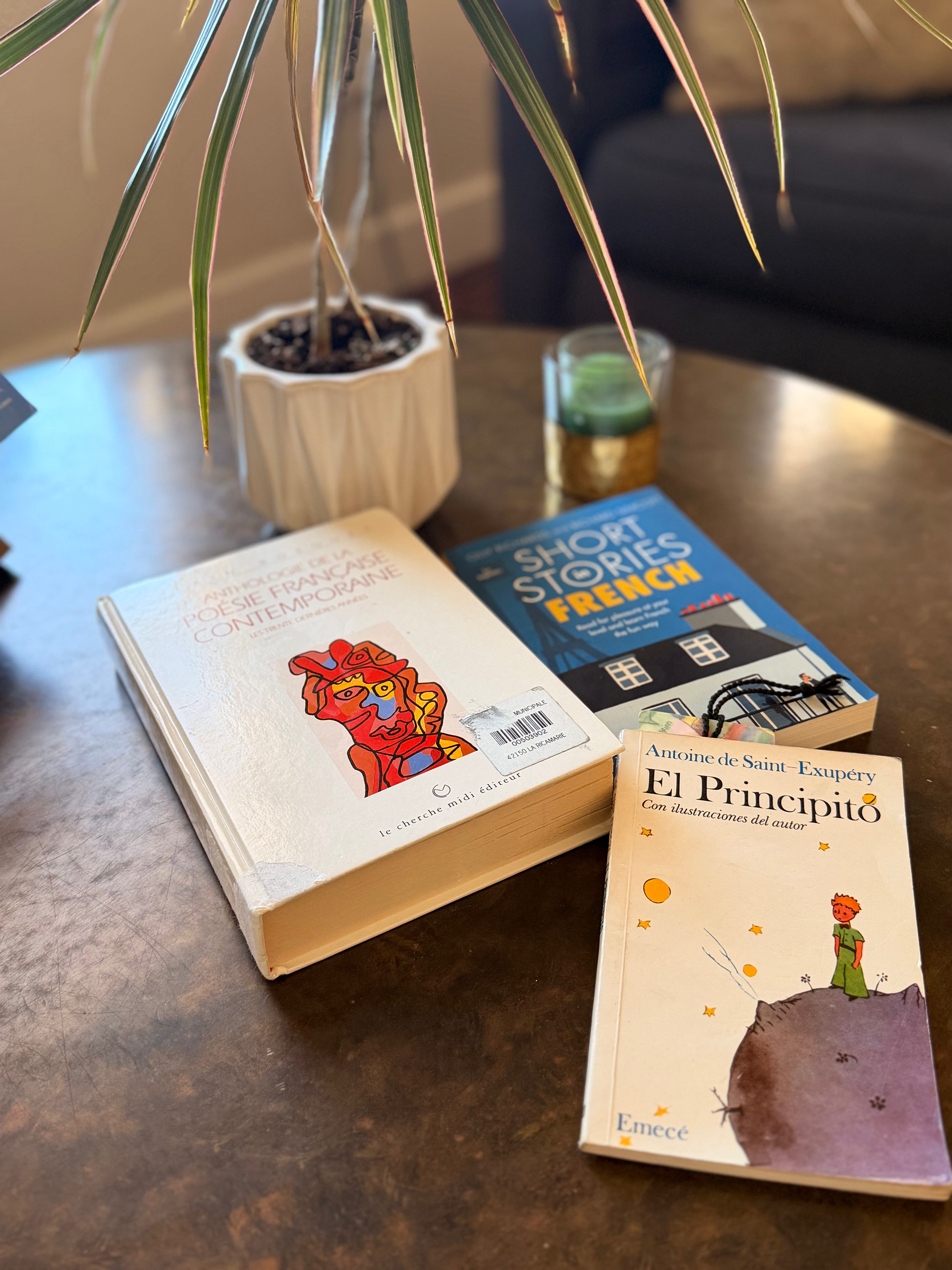
With a little help from technology, I picked up a small anthology of French poetry.
I may never need French in daily life.
But it stretches the mind.
And now, with a dictionary nearby, I’m working slowly through the poems in addition to a book I picked up long ago, but never felt I had the courage to read nor fully understand - El Principito (The Little Prince).
Together the two are the starting steps in a new, yet old school approach to learning.
⸻
A Quiet Discipline
Will this change my life in some dramatic way?
Probably not.
But sitting there with a book, a dictionary, and a notebook beside me, I sometimes feel a bit like those early monks patiently copying texts from Hebrew and Greek into Latin—preserving something worth keeping.
And in a season filled with national and international unrest, it feels oddly comforting to step away from the screens for a while.
The Stoic philosopher Epictetus once reminded his students: “First say to yourself what you would be; and then do what you have to do.”
Sometimes that simply means choosing patience over speed.
Depth over convenience.
So perhaps—with a small nod to Señora Bota—I’m giving myself a few extra credit points by learning the way she might have preferred.
Book open.
Pen in hand.
Thinking cap firmly in place.
And if I manage to roll my r’s correctly along the way, well…all the better.